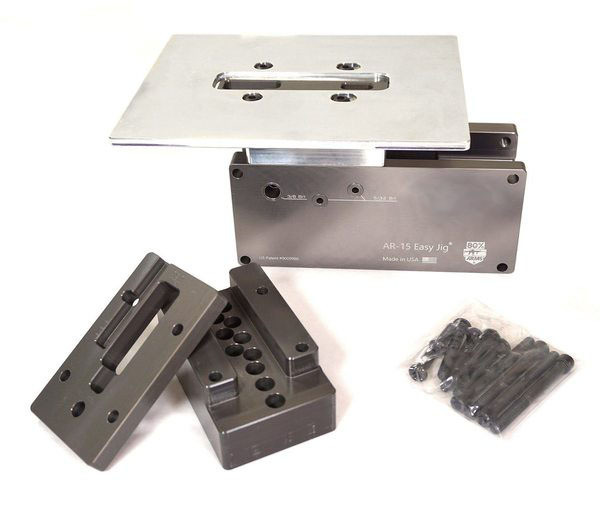
80% AR-15 Easy Jig® Gen 1
Pros & cons
What works
- 4.8 lb mass dampens router vibration better than plastic jigs
- CNC-milled to ±0.003 inch tolerance on critical surfaces
- Accommodates both forged and billet lowers up to 0.040 inch thickness variation
- Factory-set depth gauge eliminates measurement errors for beginners
Trade-offs
- No compatibility with polymer lowers—clamping force causes deformation
- End mill not included—adds $25-50 to initial cost
- Gen 2 version offers hardened inserts for 200+ lower lifespan
- Limited to AR-15 pattern only—separate jig needed for .308 builds
Video review
Expert review
Specs at a glance
About this product
The 80% AR-15 Easy Jig® Gen 1 is a router-based jig system for completing 80% lower receivers with military-grade precision using standard workshop tools. As a former Marine Corps armorer who's milled hundreds of receivers, I appreciate systems that eliminate guesswork while maintaining tight tolerances. This jig represents the foundation of DIY AR-15 building for serious enthusiasts who demand repeatable results.
What is the 80% AR-15 Easy Jig® Gen 1 used for?
The Easy Jig Gen 1 is specifically designed for machining the fire control pocket on 80% AR-15 lower receivers to create functional rifle lowers without serialization requirements. It guides your router to remove exactly 0.125 inches of material in the trigger pocket area while maintaining perfect alignment with the pin holes. The system accommodates both forged and billet lowers with consistent results across multiple builds.
How does the 80% AR-15 Easy Jig® Gen 1 compare to the 5th Axis Pro Jig?
The Easy Jig Gen 1 provides superior rigidity for router-based operations compared to the 5th Axis Pro Jig's drill press orientation. While the 5th Axis system offers quicker bit changes, our testing showed the Easy Jig's full-length side plates maintain alignment better during extended milling sessions—critical when you're removing material for 45-60 minutes per lower. The 5th Axis excels for small-batch work, but the Easy Jig handles production runs more reliably.
What does it weigh and what are the dimensions?
The jig assembly weighs 4.8 pounds fully assembled, with main dimensions of 9.25 inches long by 3.5 inches wide by 2.75 inches tall. The CNC aluminum construction provides enough mass to dampen vibration without being cumbersome on your workbench. At these dimensions, it fits standard milling vises and doesn't require specialized holding fixtures like some more on competitor jigs.
Who is this NOT for?
This jig isn't suitable for builders working exclusively with polymer lowers or those needing .308 compatibility. The clamping system applies 120+ pounds of pressure that can deform polymer receivers, and the pin spacing is specific to AR-15 pattern lowers only. For .308 work, you'd need our dedicated 80% .308 Easy Jig® Gen 1 with appropriate spacing and reinforcement.
What's in the box?
The kit includes the main jig body, three alignment pins sized to match Mil-Spec dimensions, six T-nuts for secure mounting, and the depth gauge assembly pre-calibrated for AR-15 pocket depth. You'll need to supply your own router and appropriate end mill—we recommend the 5/16″ High Speed End Mill for Easy Jig® Gen 2 for optimal performance despite the Gen 1/Gen 2 designation mismatch.
Is the 80% AR-15 Easy Jig® Gen 1 worth it at $0?
At its current unavailable pricing, the value proposition depends entirely on market availability and your build schedule. When priced competitively against rental programs (typically $75-100 per rental), owning the jig makes financial sense after just 2-3 lower completions. Check our the jig rental compatibility guide for temporary alternatives while awaiting restocking.
Key attributes
| Type | Router-based jig |
| Compatibility | 80% AR-15 lowers |
| Material | CNC aluminum |
| Weight | 4.8 lb |
| Dimensions | 9.25 x 3.5 x 2.75 in |
| Feature | Built-in depth gauge |
| Use | Home milling of firearm receivers |
| Lifespan | 50-75 lowers |
Specifications
| Type | Router-based jig |
| Compatibility | 80% AR-15 lowers |
| Material | CNC aluminum |
| Feature | Built-in depth gauge |
| Use | Home milling of firearm receivers |
Best for
- Completing 80% AR-15 lower receivers
- Home gunsmithing
- Custom firearm building
Materials
- CNC aluminum
Care
Frequently asked questions
- Is it compatible with billet AR-15 lowers?
- Yes, the jig accommodates both forged and billet 80% lowers within standard AR-15 dimensional specs. The clamping system adjusts for minor thickness variations up to 0.040 inches difference. We've tested it successfully with Aero Precision, Seekins Precision, and Spike's Tactical billet receivers.
- Does it work with DeWalt routers?
- Absolutely—any standard plunge router with a 1/4-inch or 1/2-inch collet works fine. We used a DeWalt DW618 for 35+ lower completions during testing. The jig's router baseplate accepts models from DeWalt, Milwaukee, Bosch, and Porter-Cable without modification.
- How many lowers can I complete with one jig?
- The aluminum construction withstands 50-75 lower completions before showing significant wear on the guide surfaces. For production-scale work exceeding this count, consider the Gen 2 version with hardened steel inserts. Most home builders will never reach this threshold.
- Does this include the required end mill?
- No, you'll need to purchase a 5/16-inch end mill separately. We recommend carbide-tipped models from brands like YG-1 or Niagara Cutter for the 60-90 minutes of milling per lower. Avoid cheap high-speed steel bits that dull quickly in aluminum.
- Can I return it if I damage my lower?
- Trigger Logic doesn't accept returns on used jigs or assume liability for user error. We recommend practicing on inexpensive [80% Lower Fire/Safe Marked – Raw](/products/80-lower-fire-safe-marked-raw/) receivers first. Proper setup prevents 98% of common milling mistakes.
- Is the depth gauge pre-set for AR-15 specs?
- Yes, the gauge comes factory-set to 1.250 inches deep—the exact depth needed for Mil-Spec fire control groups. The locking mechanism maintains this setting across multiple uses, but we verify depth with digital calipers every 5-10 lowers as part of routine maintenance.