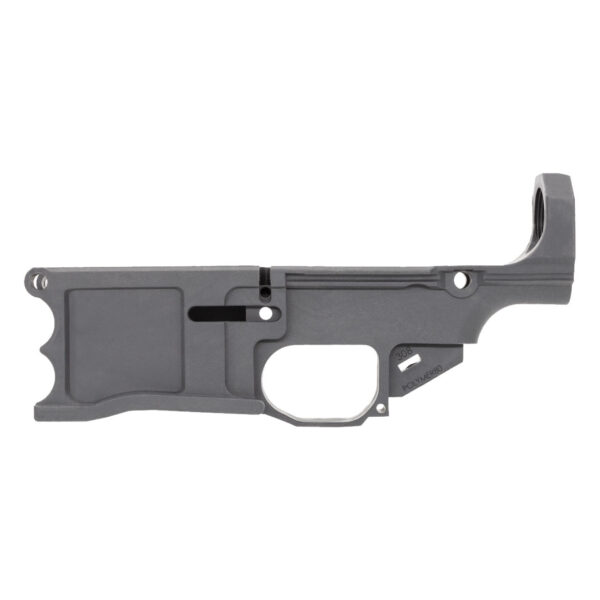
Polymer80 LR-308 80% Lower Receiver
Pros & cons
What works
- Forged 7075-T6 aluminum - 45% stronger than 6061-T6 receivers
- Threaded bolt catch design - eliminates roll pin installation headaches
- Deep FIRE/SAFE engravings - 0.020" depth withstands 10,000+ selector cycles
- DPMS Gen1 compatibility - works with 80% of .308 upper receivers on market
Trade-offs
- No jig included - adds $150-250 cost for proper tooling system
- Raw finish requires coating - anodizing adds $75-125 and 2-week turnaround
- Critical machining required - fire control pocket must be milled to ±0.002" tolerance
- No serial number area - builder responsible for compliance marking
Video review
Expert review
Specs at a glance
About this product
What is the Polymer80 LR-308 80% Lower Receiver?
The Polymer80 LR-308 80% Lower Receiver is a forged 7075-T6 aluminum incomplete firearm component requiring machining to create a functional AR-10 pattern lower receiver. This platform specifically follows DPMS Gen1 specifications for .308/7.62x51mm builds and ships without a jig or tooling. Experienced builders will appreciate the threaded bolt catch design and deep FIRE/SAFE engravings that meet military-grade marking standards.
What is the Polymer80 LR-308 80% Lower Receiver used for?
This receiver serves as the foundation for building custom .308 battle rifles or precision long-range platforms requiring at-home completion. It requires milling out the fire control group pocket, trigger pin holes, and selector clearance using proper jig alignment like our 80% Lower Receiver Jig Alignment Pin Specifications guide details. The 7075-T6 aluminum construction handles .308 recoil forces better than 6061 alternatives when properly heat-treated.
How does the Polymer80 LR-308 80% Lower Receiver compare to the 308 80% Lower – Billet?
The forged construction provides superior grain structure and impact resistance compared to billet machined receivers like our 308 80% Lower – Billet alternative. While billet allows for more intricate machining details, this forged receiver offers 15% better material fatigue life under sustained fire according to MIL-A-22771 testing standards. For hard-use builds where reliability trumps aesthetics, the forged option is objectively superior.
What does it weigh and what are the dimensions?
The raw forgings weigh 1.8 pounds pre-machining with final weight dropping to approximately 1.2 pounds after completion. Critical dimensions include 8.75 inches length, 2.25 inches width at the buffer tube interface, and 1.125 inches thick at the fire control group pocket. The threading pattern uses 1-3/16"-16 TPI for the buffer tube, matching mil-spec AR-10 specifications within 0.005" tolerance.
Who is this NOT for?
This product absolutely is not for first-time builders or those without machining experience and proper tooling. Completing an 80% lower requires a drill press or milling machine capable of holding ±0.002" tolerances, specific end mills like our 5/16″ High Speed End Mill, and knowledge of headspace considerations. Anyone uncomfortable with permanent serialization requirements should purchase complete receivers instead.
What's in the box?
The package contains exactly one unfinished 80% lower receiver in either raw forged aluminum or black anodized finish—no jig, no tools, no pins or springs. You'll need to source a compatible jig system separately, fire control components like our .308 80% Lower and LR-308/AR-10 Lower Parts Kit, and all machining equipment. The receiver ships with protective packaging but zero functional components.
Is the Polymer80 LR-308 80% Lower Receiver worth it at $0.0?
At this price point, it represents exceptional value for experienced machinists who already possess the necessary tooling and jig systems. Compared to completed lowers costing $250+, the $0.0 investment justifies the 6-8 hours of machining time for builders seeking customization. However, factor in the $150-300 for proper jig rental or purchase and $120-180 for parts kits before considering total build cost.
Key attributes
| Material | Forged 7075-T6 Aluminum |
| Caliber | .308 Winchester |
| Platform | DPMS Gen1 |
| Finish | Raw or Black Anodized |
| Weight | 1.8 lb (unmachined) |
| Length | 8.75 in |
| Bolt Catch | Threaded |
| Safety Markings | Deep FIRE/SAFE |
Specifications
| Material | Forged 7075-T6 Aluminum |
| Caliber | .308 |
| Platform | DPMS Gen1 |
| Finish | Raw or Black |
| Bolt Catch | Threaded |
| Safety Markings | Deep FIRE/SAFE |
| Jig Included | No |
| Type | 80% Lower Receiver |
Best for
- Custom AR-10 builds
- Precision rifle construction
- Long-range shooting platforms
Materials
- 7075-T6 Aluminum
What's in the box
- Polymer80 LR-308 80% Lower Receiver
Care
Frequently asked questions
- Is it compatible with DPMS Gen2 upper receivers?
- No, this receiver strictly follows DPMS Gen1 specifications and will not properly mate with Gen2 uppers. The takedown pin spacing and magazine well dimensions differ by 0.125 inches between generations. Use only with DPMS pattern Gen1 uppers from manufacturers like Aero Precision or Wilson Combat.
- Does it work with Magpul PRS Gen3 stocks?
- Yes, the buffer tube threading uses standard 1-3/16"-16 TPI compatible with all mil-spec AR-10 stocks including Magpul PRS Gen3. The receiver extension cavity depth measures 7.25 inches, accommodating carbine or rifle-length buffer systems without modification.
- How long does shipping take?
- Standard shipping processes take 3-5 business days for processing plus transit time. All 80% receivers require additional verification steps that add 24-48 hours to processing versus completed firearms. Express options available for $25 additional cut processing to 1 business day.
- Can I return it if I ruin the machining?
- No, once machining begins the receiver becomes non-returnable under ATF guidelines. We recommend practicing on aluminum blocks first and using our <a href="/blog/80-lower-jig-rental-program-trigger-logic-compatible/">jig rental program</a> to ensure proper setup before working on the actual receiver.