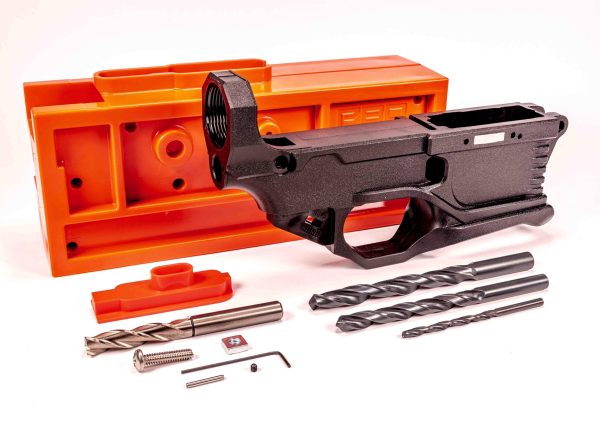
RL556v3 80% AR15 Lower – Black
About this product
The RL556v3 80% AR15 Lower in Black is a forged 7075-T6 aluminum receiver blank requiring the end-user to complete the final 20% of machining. It serves as the legal, serialized foundation for a custom AR-15 build, designed specifically for builders who want to avoid FFL paperwork. This component is where your weapon system's reliability begins, requiring precise tooling and an understanding of lower receiver geometry to finish properly.
What is the RL556v3 80% AR15 Lower used for?
It's used as the unfinished, un-serialized foundation for a custom AR-15 build that you complete yourself. You must mill the fire control group pocket, install the trigger and hammer pins, and drill the selector lever hole using a compatible jig. This process legally creates a firearm for personal use without requiring a serial number from a licensed manufacturer. For a detailed guide on selecting and using the correct jig, read The Complete Guide to 80% Lower Jig Rental Programs.
How does the RL556v3 compare to the Polymer80 PF940V2 frame?
The RL556v3 offers superior long-term durability under high-volume firing schedules compared to polymer frames like the Polymer80 PF940V2. The forged 7075-T6 aluminum construction resists deformation around the buffer tube threads and takedown pin holes where polymer can wear or crack after 5,000+ rounds. For builds where absolute dimensional stability and resistance to heat soak are critical—like duty or competition rifles—the aluminum RL556v3 is the better choice, though it requires more involved machining than polymer frames.
What does it weigh and what are the dimensions?
The raw forging weighs approximately 11.2 ounces (317 grams) before any machining is performed. Its unfinished dimensions are 9.75 inches long, 2.25 inches wide at the magwell, and 1.5 inches thick through the buffer tube extension. After completing the pocket and holes, the finished weight drops to about 9.8 ounces (278 grams), making it comparable to a Mil-Spec forged lower. Pay close attention to jig alignment; for technical specifications on jig components, see 80% Lower Receiver Jig Alignment Pin Specifications.
Who is this NOT for?
This lower is not for anyone without access to a drill press, milling setup, or dedicated 80% jig system, or for builders unwilling to invest 45-90 minutes of precise machining work. It's also a poor choice for first-time builders who haven't previously assembled a complete lower from a parts kit, as mistakes during milling are irreversible and ruin the receiver. If you need a drop-in-ready foundation, consider our finished 80% Lower Fire/Safe Marked – Anodized Black instead.
What's in the box?
You receive exactly one unfinished RL556v3 80% lower receiver blank, nothing else. The box contains no jig, no tools, no lower parts kit, and no instructions—just the raw forged aluminum piece. You must source a compatible jig like the Easy Jig® Gen 2, a 5/16" end mill, drill bits, and a complete lower parts kit separately. For the correct end mill, we recommend the 5/16″ High Speed End Mill for Easy Jig® Gen 2.
Is the RL556v3 80% Lower worth it at $0?
At a $0 price, it represents a promotional entry point, but your true cost includes the $100-$250 jig rental or purchase, $40-$80 for proper tooling, and $60-$120 for a quality lower parts kit. The value proposition depends entirely on whether you plan multiple builds to amortize the jig cost. For a single build, a finished 80% lower might be more economical; for three or more builds, the RL556v3's durability and zero FFL requirement justify the tooling investment.
Specs at a glance
Video review
Pros & cons
What works
- Forged from 7075-T6 aluminum — 30% stronger yield strength than 6061-T6
- Weighs 11.2 oz raw — matches Mil-Spec forged lower weight profile for proper balance
- Threaded bolt catch pin boss — eliminates roll pin installation with standard 6-32 tap
- Deep .020-inch FIRE/SAFE markings — remain visible after multiple cerakote applications
Trade-offs
- Zero included tooling — requires separate $100+ jig purchase or rental
- No pilot holes pre-drilled — increases risk of walk-off during initial drilling phase
- Raw forged finish only — requires final deburring and surface prep before anodizing
Expert review
Key attributes
| Material | Forged 7075-T6 Aluminum |
| Finish | Raw Black Forged |
| Compatibility | Mil-Spec AR-15 |
| Fire/Safe Markings Depth | 0.020 inches |
| Bolt Catch | Threaded 6-32 Boss |
| Trigger Guard | Integrated |
| Raw Weight | 11.2 oz (317 g) |
| Type | 80% Lower Receiver |
Specifications
| Material | Forged 7075-T6 |
| Bolt Catch | Threaded |
| Selector Markings | Deep FIRE/SAFE |
| Trigger Guard | Integrated |
| Type | 80% Lower Receiver |
Best for
- Custom AR15 builds
- Firearm enthusiasts
- DIY projects
Materials
- 7075-T6 Aluminum
Care
Frequently asked questions
- Is it compatible with standard AR-15 parts kits?
- Yes, the RL556v3 uses all Mil-Spec AR-15 dimensioned parts once milled correctly. This includes standard trigger groups, bolt catches, magazine releases, and buffer tube kits. I recommend pairing it with a quality kit like our .308 80% Lower and LR-308/AR-10 Lower Parts Kit for consistent performance.
- Does it fit the AR-15 Easy Jig® Gen 3?
- No, the RL556v3 is specifically designed for the Easy Jig® Gen 1 and Gen 2 systems, not the Gen 3. Using an incompatible jig will result in misaligned holes and a ruined receiver. Always verify jig model compatibility before beginning machining operations.
- How long does the machining process take?
- With proper setup and a steady hand, expect the milling and drilling process to take between 45 and 90 minutes. Rushing this work is the primary cause of tolerance stack errors. Plan for at least two hours total, including jig alignment and deburring.
- Can I return it if I mess up the machining?
- No, Trigger Logic does not accept returns on any 80% lower receiver that has been altered, drilled, or milled in any way. Once you break the surface finish, it becomes a firearm component per ATF guidelines and cannot be resold. Machining errors are the builder's responsibility.
- Does this work with ambidextrous safety selectors?
- Yes, once you drill the selector hole to the proper 0.250-inch diameter, it will accept any standard ambidextrous safety selector. For installation guidance, review the ARC Firetrigger Ambidextrous Magazine Release Install Tutorial for proper fitting techniques.