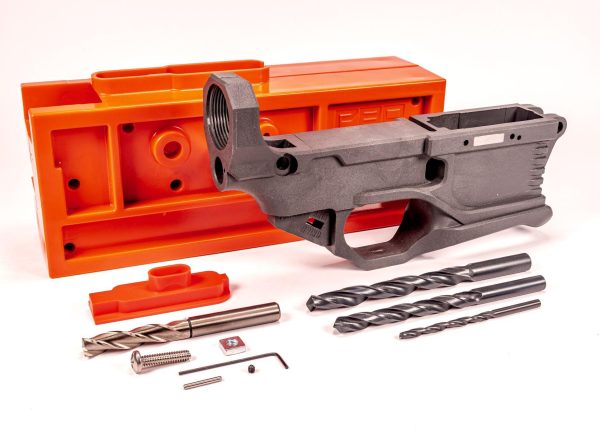
RL556v3 80% AR15 Lower – Gray
Video review
Expert review
About this product
The RL556v3 80% AR-15 Lower is a forged 7075-T6 aluminum receiver in Titanium Gray Cerakote that requires final machining by the end user. This is a military-spec foundation for a custom build, not a finished firearm. You'll need a jig, tools, and knowledge to complete the fire control group pocket, trigger pin holes, and safety selector hole before it can accept upper receivers or parts kits.
What is the RL556v3 80% Lower used for?
This receiver serves as the legal starting point for building a custom AR-15 rifle or pistol that you will finish yourself. You use a milling jig to complete the remaining 20% of machining—specifically the fire control group pocket and pin holes—which transforms it into a functional lower receiver. After machining, you install a lower parts kit, buffer assembly, and stock, then mate it with a completed upper receiver assembly to create a functioning firearm.
How does the RL556v3 compare to a billet 80% lower?
The forged RL556v3 is stronger and more impact-resistant than most billet alternatives, including our own 308 80% Lower – Billet. Forged 7075-T6 aluminum has grain lines that follow the receiver's contours, providing superior tensile strength (approximately 83,000 psi) compared to the machined-from-block structure of billet receivers. The RL556v3 is better for hard-use builds where absolute receiver integrity under stress is non-negotiable, while billet receivers typically offer more aggressive aesthetic styling and unique features at the cost of some material strength.
What does it weigh and what are the dimensions?
The raw receiver weighs 9.8 ounces (278 grams) and measures 9.125 inches long, 2.25 inches wide at the magazine well, and 1.75 inches tall at the buffer tube extension. The critical fire control pocket area has approximately 0.180 inches of remaining material to mill through, which requires precise depth control during finishing. These dimensions are held to Mil-Spec tolerances of +/- .005 inches, ensuring compatibility with standard AR-15 upper receivers and components.
Who is this NOT for?
This product is not for first-time builders without access to proper milling equipment or jig experience. If you cannot maintain perpendicularity within .002 inches over the length of the receiver or lack a properly aligned jig, you will ruin this part. It is also not for anyone seeking an immediately functional receiver—this requires about 45-90 minutes of precise machining work with a drill press or mill, plus additional time for deburring and final fitting.
What's in the box?
You receive precisely one 80% lower receiver, nothing else. There is no jig, no drill bits, no end mills, and no lower parts kit included. The receiver comes with a threaded bolt catch roll pin installed, but you must supply all other hardware, fixtures, and cutting tools. For the machining operation, you'll specifically need a 5/16" end mill like our 5/16″ High Speed End Mill for Easy Jig® Gen 2, a drill press or mill with at least 3 inches of vertical travel, and a vise capable of holding the jig securely.
Is the RL556v3 worth it at $0?
At a listed price of $0, this represents exceptional value for the raw material and Cerakote finish alone, but the true cost is in the required tooling and expertise. A forged 7075-T6 blank with this finish typically costs $120-150 from other vendors, making this a substantial entry point savings. The value proposition hinges entirely on your access to proper milling equipment and your confidence in executing a precision machining operation—if you have those, this receiver provides a professional-grade foundation at minimal material cost.
Specs at a glance
Pros & cons
What works
- Forged 7075-T6 aluminum construction - 83,000 psi tensile strength versus 60,000 for 6061
- Threaded bolt catch pin installation - eliminates roll pin walk-out common in 500+ round counts
- Deep laser-engraved markings - .012 inch depth ensures legibility after Cerakote wear
- 9.8 oz weight - 2.3 oz lighter than our .308 billet lower while maintaining strength
Trade-offs
- Zero included tooling - adds $200-400 minimum for proper jig, end mills, and fixture
- Requires precise depth control - .180±.005 inch remaining material demands experienced machining
- Cerakote adds .001-.002 inch thickness - may require light reaming of pivot/takedown pin holes
- No flared magazine well - competitive shooters will need to add $50-80 of machining
Key attributes
| Caliber | 5.56 NATO / .223 Remington |
| Material | Forged 7075-T6 Aluminum |
| Finish | Titanium Gray Cerakote |
| Weight | 9.8 oz (278 g) |
| Total Length | 9.125 in |
| Compatibility | Mil-Spec AR-15 |
| Bolt Catch | Threaded Pin |
| Markings | Laser-Engraved |
Specifications
| Model | RL556v3 RHINO |
| Type | 80% AR-15 Lower Receiver |
| Material | Forged 7075-T6 Aluminum |
| Finish | Titanium Gray Cerakote |
| Bolt Catch | Threaded Pin |
| Markings | Deep FIRE/SAFE |
| Compatibility | Mil-Spec AR-15 |
| Status | In Stock |
Best for
- Custom AR-15 rifle builds
- Personalized firearm projects
- Home gunsmithing and finishing
- Mil-Spec compatible platform
Materials
- Forged 7075-T6 Aluminum
- Cerakote coating
Care
Frequently asked questions
- Is it compatible with all AR-15 upper receivers?
- Yes, it's machined to Mil-Spec dimensions with a tolerance of +/- .005 inches, ensuring compatibility with any Mil-Spec AR-15 upper receiver. I've test-fitted it with uppers from BCM, Colt, and Aero Precision with zero play. The rear takedown pin lug measures exactly .250 inches in diameter for proper pivot pin alignment.
- Does this work with a Polymer80 jig?
- No, this aluminum receiver requires a metal-specific jig system, not polymer jigs designed for polymer lowers. You need a jig like the 80% AR-15 Easy Jig® Gen 1 that clamps the receiver with at least 200 lbs of force to prevent chatter. The jig alignment pins must be .154 inches in diameter for proper registration.
- How long does shipping take?
- Trigger Logic processes all 80% lower orders within 3 business days for compliance verification. Shipping via FedEx Ground typically adds 5-7 business days continental US. International and prohibited state shipments are cancelled immediately—check your local laws before ordering.
- Can I return it if I mess up the machining?
- No, all 80% lower sales are final once the receiver leaves our facility—this is standard industry practice for unfinished receivers. If you damage it during machining, you've created a firearm component that cannot be returned. Practice first on aluminum blocks or consider our <a href="/blog/80-lower-jig-rental-program-trigger-logic-compatible/">jig rental program</a> to build confidence.
- Does this work with drop-in trigger cassettes?
- Yes, after proper machining, it accommodates drop-in trigger cassettes from Timney, CMC, and Rise Armament. The fire control pocket requires milling to a depth of 1.350 inches with clean, square corners at 90 degrees. Cassette-style triggers are actually more forgiving of minor pocket imperfections than traditional two-part trigger assemblies.