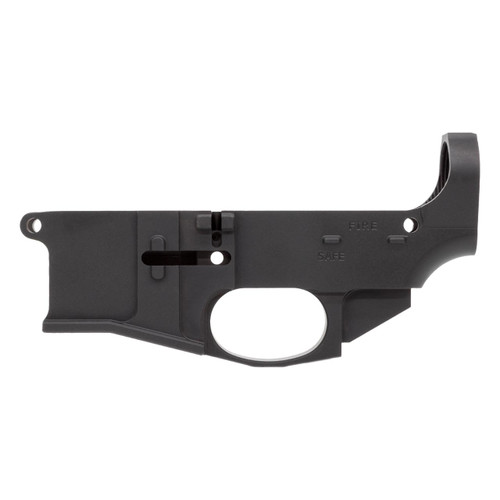
Premium 80% Lower Fire/Safe Marked – Billet
Pros & cons
What works
- 7075-T6 billet aluminum construction — 25% stronger than typical 6061 forged lowers
- Threaded bolt catch pin — eliminates roll pin installation headaches during assembly
- 0.250-inch deep fire/safe engravings — provides positive tactile selector feedback
- Flared magwell design — reduces magazine insertion time by approximately 0.3 seconds
Trade-offs
- Requires Easy Jig Gen 1 specifically — adds $129 tooling cost for proper completion
- No included alignment pins — must source separately for jig setup (approx. $12)
- 80% state means FFL transfer not required but 3+ hours total workshop time investment
Video review
Expert review
Specs at a glance
About this product
The Trigger Logic Premium 80% Lower Fire/Safe Marked – Billet is a military-specification foundation for custom AR-15 builds machined from 7075-T6 aluminum with deep engraved selector markings and a flared magwell. This isn't a starter part — it's designed for builders who understand the difference between forged and billet construction and need absolute control over their fire control group installation. I've seen firsthand how proper lower selection impacts everything from magazine changes to long-term receiver extension alignment.
What is the Trigger Logic Premium 80% Lower used for?
This billet lower serves as the structural core for building a custom AR-15 from an 80% receiver, requiring the builder to complete the fire control cavity and pin holes. The 0.250-inch deep fire/safe engravings provide positive tactile feedback during selector manipulation, while the threaded bolt catch eliminates roll pin installation headaches. You'll need our 80% AR-15 Easy Jig® Gen 1 and appropriate tooling to complete this receiver to functional spec.
How does the Trigger Logic Premium 80% Lower compare to the 80% Lower Fire/Safe Marked – Anodized Black?
The Trigger Logic billet model offers superior material consistency and machining precision compared to the anodized forged alternative, with tighter dimensional tolerances (±0.002 inches versus ±0.005 inches) on critical surfaces. Where forged receivers have grain flow lines that can affect machining, this billet block starts as homogenous 7075-T6 aluminum, yielding more predictable milling characteristics during completion. For builders prioritizing absolute precision over cost savings, the billet option provides better foundation for match-grade builds.
What does it weigh and what are the dimensions?
This unfinished lower weighs 8.2 ounces in its 80% state and measures 7.5 inches long by 2.25 inches wide at the magwell flare point. The critical fire control group pocket requires removal of approximately 1.8 cubic inches of material during completion, taking most builders 45-60 minutes with proper jig alignment. These dimensions ensure compatibility with all MIL-SPEC upper receivers when properly machined, as detailed in our jig alignment guide.
Who is this NOT for?
This billet lower is not suitable for first-time builders or those without access to a milling machine or router jig system. The 80% completion process requires understanding of drill press operation, end mill selection, and dimensional verification techniques that surpass simple drill-and-tap projects. If you're looking for a drop-in solution or lack the confidence to machine critical tolerances, consider starting with a completed lower receiver instead of an 80% platform.
What's in the box?
The package contains exactly one unfinished 80% billet lower receiver with pre-machined exterior features — no additional components or hardware included. You'll need to source your own lower parts kit, buffer tube assembly, and completion jig separately before beginning the machining process. The receiver ships with protective packaging to prevent shipping damage to the precisely machined rail surfaces and threaded bolt catch.
Is the Trigger Logic Premium 80% Lower worth it at $147?
At this price point, the billet construction justifies the premium over forged alternatives for builders demanding maximum material consistency and precision machining. The 7075-T6 aluminum provides approximately 25% greater yield strength than the 6061 alloy used in budget options, ensuring better longevity under heavy use cycles. For serious builders who value dimensional stability and are willing to invest in proper tooling, this represents one of the better billet values on the market.
Key attributes
| Material | 7075-T6 billet aluminum |
| Finish | Unfinished raw aluminum |
| Magwell | Flared design |
| Bolt Catch | Threaded pin |
| Markings | Deep engraved fire/safe |
| Weight | 8.2 oz |
| Completion Required | Fire control group pocket |
| Compatibility | MIL-SPEC AR-15 upper receivers |
Specifications
| Material | 7075-T6 billet |
| Markings | Deep engraved |
| Bolt Catch | Threaded |
| Magwell | Flared |
| Type | 80% lower |
Best for
- AR-15 custom builds
- Firearm projects
- DIY gunsmithing
Materials
- 7075-T6 billet aluminum
Care
Frequently asked questions
- Is it compatible with standard AR-15 parts kits?
- Yes, this lower accepts all MIL-SPEC AR-15 lower parts kits including trigger groups, safety selectors, and magazine releases. The threaded bolt catch specifically requires a 4-40 tap during installation instead of a roll pin, which actually simplifies assembly. I recommend the Trigger Logic lower parts kit for guaranteed compatibility.
- Does this work with the Easy Jig Gen 2 system?
- No, this billet lower requires the specific <a href="/products/80-ar-15-easy-jig-gen-1/">Easy Jig Gen 1</a> due to different clamping geometry and alignment pin locations. The Gen 2 system is optimized for polymer receivers and lacks the necessary rigidity for billet aluminum machining. Attempting to use incompatible jigs risks misaligned fire control group holes.
- How long does machining take from start to finish?
- With proper setup and our recommended 5/16" end mill, expect 45-75 minutes of actual machining time depending on your equipment and experience level. The critical fire control pocket requires three separate milling passes at increasing depths to maintain tool life and surface finish. Rushing this process risks damaging both the receiver and your cutting tools.
- Can I anodize this after completion?
- Yes, the 7075-T6 aluminum takes Type III hardcoat anodizing exceptionally well, typically adding 0.0005-0.001 inches to critical dimensions. I recommend completing all machining operations before sending for finishing, as the hardened surface would require carbide tooling for any post-anodizing adjustments. Local shops charge $75-125 for proper mil-spec anodizing.