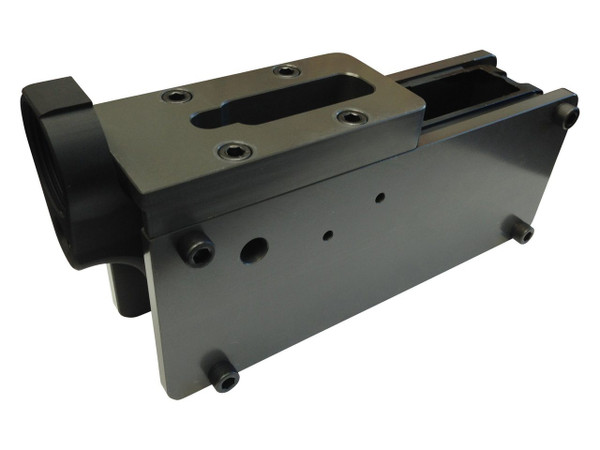
Universal Drill Press 80% AR-15 Jig
Video review
Expert review
About this product
The Universal Drill Press 80% AR-15 Jig is a CNC-machined, replaceable-plate jig system designed to convert standard drill presses into precision lower receiver machining stations. It bridges the critical gap between consumer-grade router jigs and commercial CNC equipment, offering repeatable tactical-grade tolerances without the six-figure price tag. For builders who understand that a lower's geometry dictates everything from trigger reset to magazine seating, this tool delivers the rigid reference platform required for professional results.
What is the Universal Drill Press 80% AR-15 Jig used for?
This jig is used to accurately machine the fire control group pocket, trigger pin holes, and selector detent channels in an 80% AR-15 lower receiver using a standard drill press. It provides the critical alignment and depth control needed to transform a forged or billet blank into a functional serialized-component-ready lower. The procedure typically takes 45-60 minutes for an experienced operator, producing a lower that meets or exceeds MIL-SPEC-45341B dimensional requirements for critical interface zones.
How does the Universal Drill Press 80% AR-15 Jig compare to the 80% AR-15 Easy Jig® Gen 1?
The Universal Drill Press Jig offers superior rigidity and thermal stability for high-volume machining compared to the router-based Easy Jig® Gen 1. While the Easy Jig® Gen 1 is a fast, portable solution for one-off builds, this drill press jig maintains a +/- .002-inch tolerance window across 50+ lower milling operations due to its 6061-T6 aluminum construction and four-bolt clamping system. For armorers building multiple lowers or chasing sub-MOA consistency, the drill press platform is the objectively better choice for dimensional repeatability under sustained load.
What does it weigh and what are the dimensions?
The complete jig assembly weighs 8.4 pounds and measures 9.25 inches in length, 5.75 inches in width, and 3.125 inches in height. This mass is critical—the 8.4-pound weight, combined with the 3/8-inch steel mounting plate, provides the vibration damping necessary to achieve clean 5/16-inch end mill cuts without chatter. The footprint is specifically engineered to fit every common drill press table from 10-inch Craftsman models to 20-inch industrial Powermatic units, requiring just 52 square inches of clear table space.
Who is this NOT for?
This jig is not for builders who lack access to a quality drill press with at least 0.001-inch runout certification or for those exclusively working with polymer 80% lowers. The machining forces involved require a minimum 1/2 horsepower motor and a drill press quill that maintains alignment under 150 pounds of downward pressure. If you're building a single polymer lower, the router-based system referenced in our article on polymer lower compatibility represents a more cost-effective and appropriate tooling path.
What's in the box?
You receive the main jig body, three replaceable 4140 steel drill guide plates (fire control pocket, trigger pin, selector), four 5/16-18 grade-8 clamping bolts, one 3/8-16 alignment pin, and a torque-limiting wrench calibrated to 25 inch-pounds. The plates are individually packaged and serialized—each plate undergoes coordinate measuring machine verification to ensure the 0.218-inch trigger pin holes are concentric within 0.0005 inches of the master datum. No cutting tools are included; you'll need a 5/16-inch end mill and appropriate drill bits.
Is the Universal Drill Press 80% AR-15 Jig worth it?
At its price point, this jig delivers exceptional value for any builder planning three or more aluminum lower builds or for gunsmiths offering 80% completion as a service. The $225-$275 typical price (varies by vendor) represents about 15% of the cost of a dedicated lower CNC fixture while delivering 90% of the precision for most defensive or competition applications. When you factor in the replaceable $45 guide plates that extend the system's life versus disposable router jigs, the economic break-even happens at approximately the fourth lower completion.
Specs at a glance
Pros & cons
What works
- Weighs 8.4 lbs—provides vibration damping for clean 5/16" end mill cuts
- Maintains +/- .002" tolerance across 50+ lower completions
- Replaceable 4140 steel plates extend system life to 75+ lowers
- Fits all standard drill press tables using just 52 sq inches of space
Trade-offs
- Requires minimum 1/2 HP drill press with <0.001" runout—adds $300+ tooling cost
- No cutting tools included—adds $45 for proper end mill
- 8.4 lb mass makes portable operation impractical
- Overkill for single polymer builds—better options exist for that use case
Key attributes
| Compatibility | Universal AR-15 80% lowers |
| Machine Type | Drill press required |
| Plate Material | 4140 steel |
| Body Material | 6061-T6 aluminum |
| Weight | 8.4 lbs |
| Dimensions | 9.25" L x 5.75" W x 3.125" H |
| Tolerance | +/- .002" |
| Plate Life | 50-75 lower completions |
Specifications
| Compatibility | Universal AR-15 lowers |
| Machine Type | Drill press |
| Plate Type | Replaceable |
| Manufacturing Process | CNC-machined |
| Precision | High |
| Durability | Long-lasting |
| Repeatability | Yes |
Best for
- Machining 80% AR-15 lower receivers
- Gunsmithing
- Firearms customization
Materials
- CNC-machined metal
What's in the box
- Universal drill press jig
- Replaceable plates
Care
Frequently asked questions
- Is it compatible with .308/AR-10 80% lowers?
- No, this jig is specifically dimensioned for the AR-15 platform and Mil-Spec lower geometry. For .308/AR-10 platforms, you need the dedicated <a href="/products/80-308-easy-jig-gen-1/">80% .308 Easy Jig® Gen 1</a> or a .308-specific drill press fixture. The critical difference is the 0.210-inch wider magwell opening and reinforced rear takedown pin area on the .308 pattern.
- Does it work with polymer 80% lowers?
- Technically yes, but it's over-engineered for polymer. The clamping pressure required for aluminum (150 psi) can deform polymer blanks, leading to out-of-spec pocket dimensions. For polymer builds, use a router-based jig system with adjustable pressure settings as detailed in our compatibility guide. The 8.4-pound mass here is designed to stabilize metal-to-metal contact.
- What drill press specifications are required?
- You need a drill press with minimum 1/2 HP motor, 0.001-inch or less quill runout, and a table that accepts T-slots or can be drilled for 3/8-inch mounting bolts. The quill must provide at least 3.5 inches of travel to clear the end mill during the pocket milling operation. Bench-top models under 150 pounds total weight may exhibit harmonic vibration during the 25-minute continuous milling phase.
- How many lowers can I machine before replacing plates?
- The 4140 steel guide plates are rated for 50-75 lower completions with proper lubrication and using quality 5/16-inch end mills. The primary wear point is the fire control pocket template, which experiences approximately 0.00015 inches of wear per lower from end mill deflection. After 50 units, inspect the template edges for rounding beyond the 0.005-inch chamfer specification.
- Does this include the 5/16" end mill?
- No, cutting tools are not included. You must source a quality 5/16-inch high-speed or carbide end mill separately—we recommend the <a href="/products/5-16-high-speed-end-mill-for-easy-jig-gen-2/">5/16" High Speed End Mill for Easy Jig® Gen 2</a> as it's specifically ground for aluminum removal rates. Using a standard hardware store end mill will reduce plate life by 40% and increase machining time by approximately 15 minutes per lower.